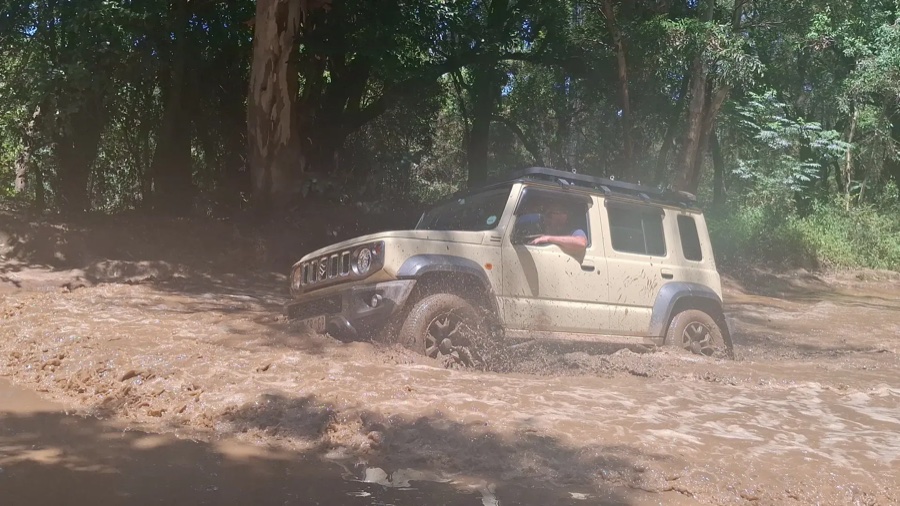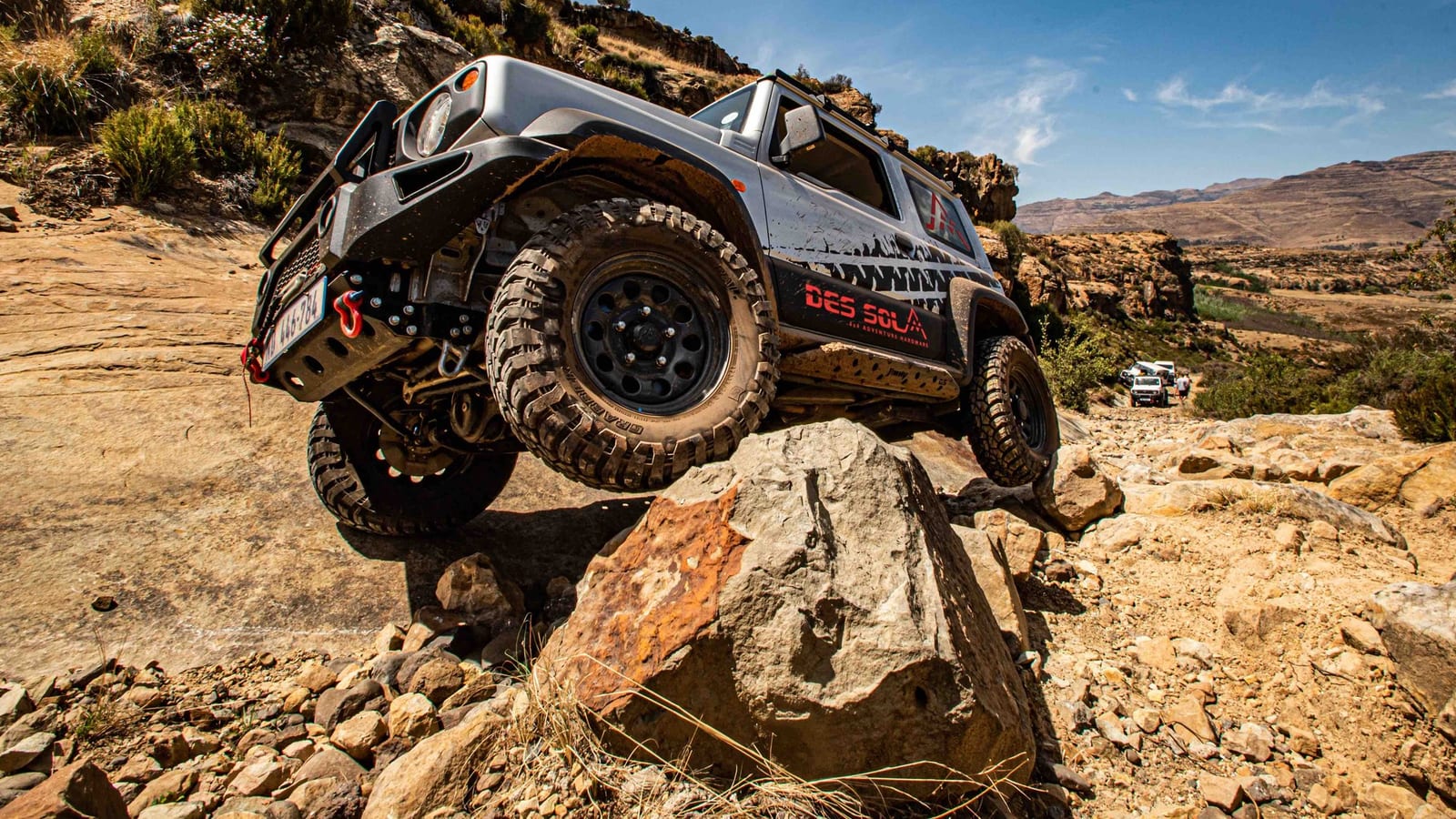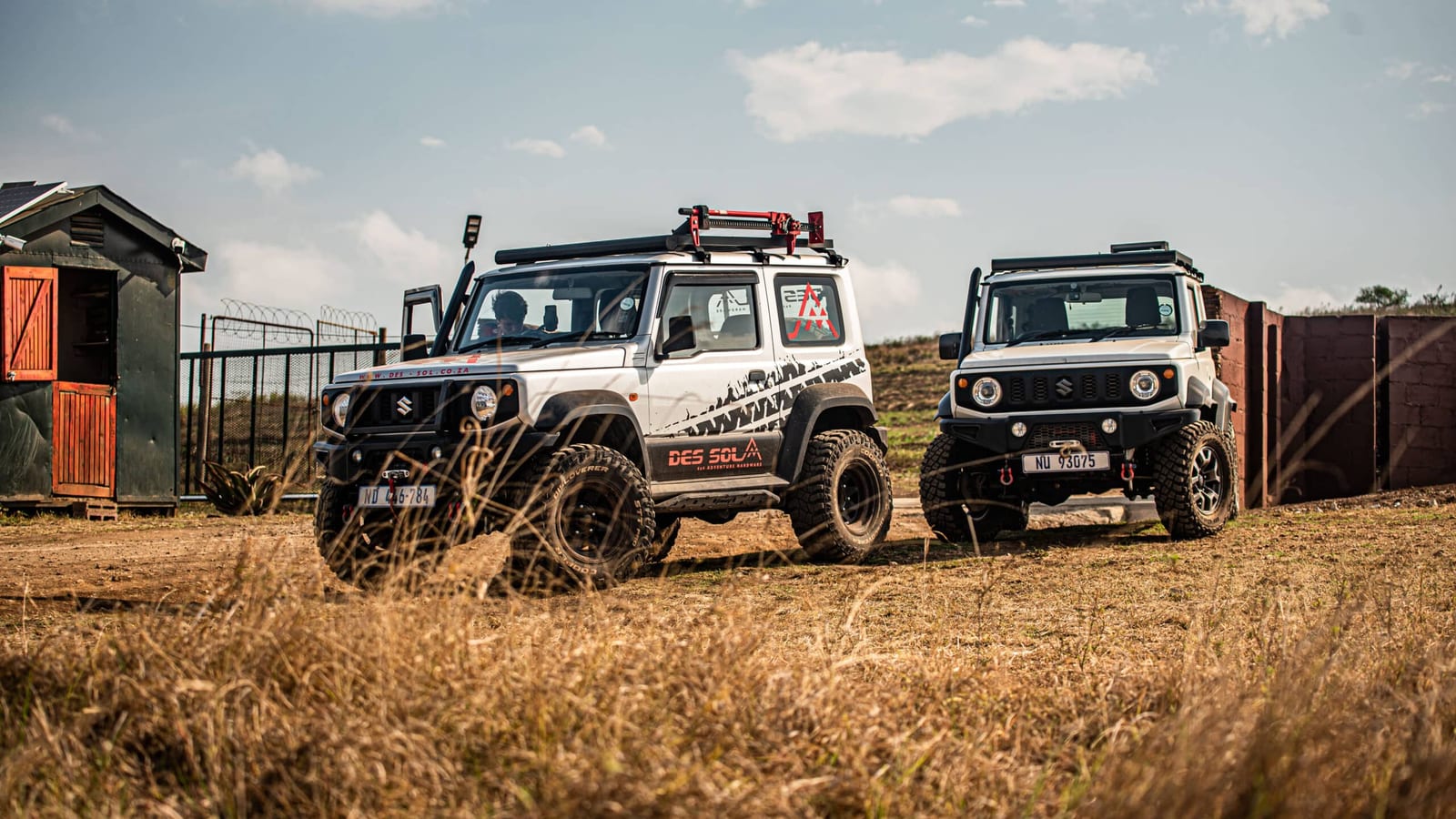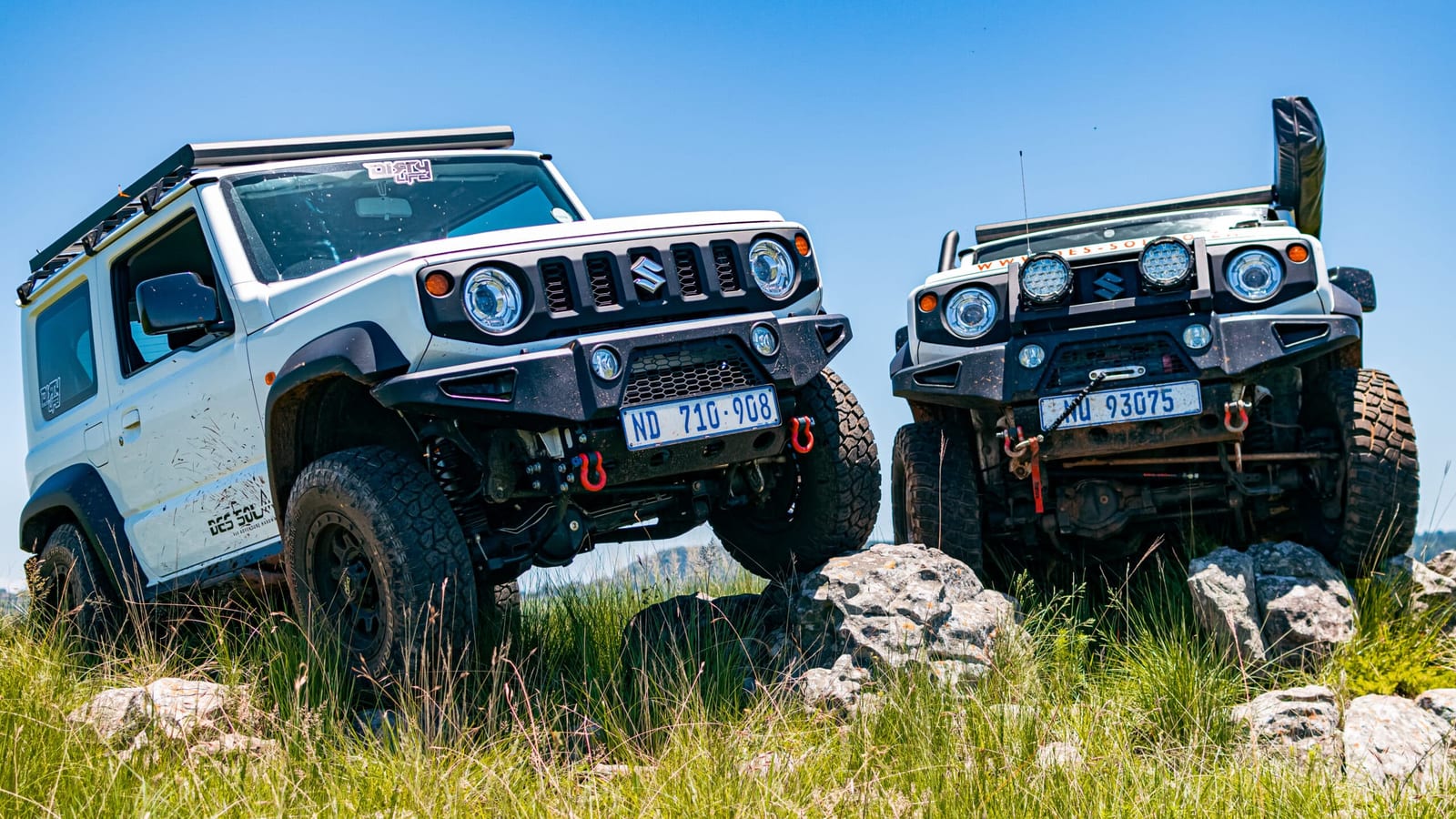
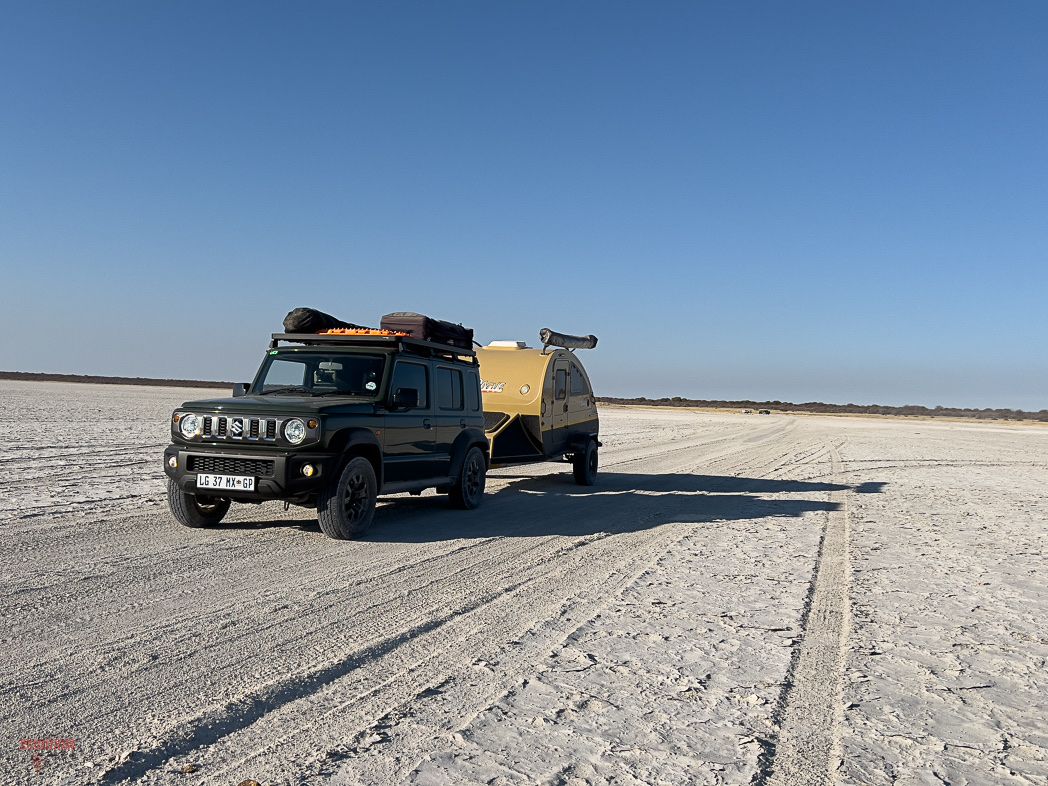
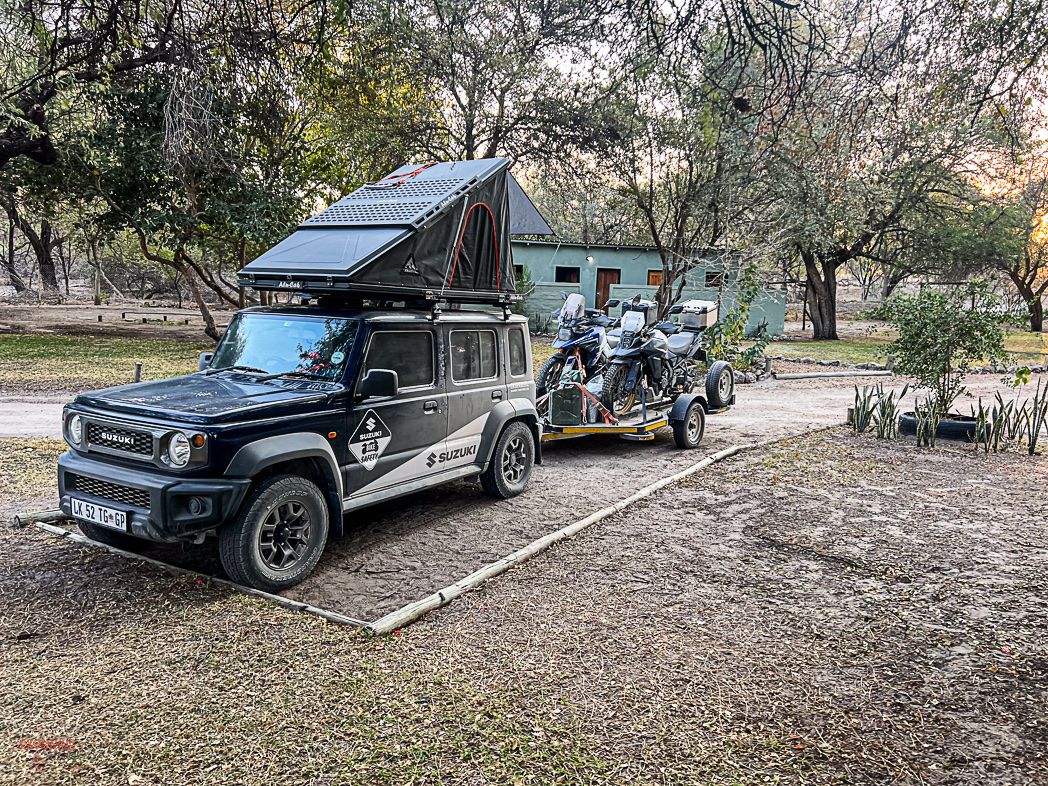
Cover photo: Anton Willemse / 4x4 Afrika, from their Jimny tow test through Botswana. Thank you, 4x4 Afrika, for doing the test the rest of us argue about.
Every Jimny towing thread on the forums splits into two questions. Can it tow? And is it legal? They are not the same thing.
Suzuki gives you the first answer. The road traffic rules and your driver’s licence give you the second, and the second one is lower.
How much can a Suzuki Jimny tow?
Suzuki Auto South Africa rates the 3-door Jimny to tow 1,300 kg with a braked trailer and 350 kg with an unbraked one. A braked trailer has its own brakes. On small SA trailers these are run-in brakes, also called overrun brakes. They press on by themselves when the car slows and the trailer pushes forward.
| Jimny | Braked trailer | Unbraked trailer | Weight empty |
|---|---|---|---|
| 3-door manual | 1,300 kg | 350 kg | 1,095 kg |
| 3-door auto | 1,300 kg | 350 kg | 1,110 kg |
| 5-door (all) | Not published | Not published | 1,185 to 1,215 kg |
Figures from Suzuki Auto South Africa’s spec pages, seen on 23 September 2026.
The manual and the auto get the same rating, so the auto buyer gives nothing up.
You may see 1,095 kg or 1,110 kg quoted online as the Jimny’s towing limit. Those are the weights of the 3-door manual and auto themselves, not what they may tow.
For its size, the rating is strong. It is 300 kg more than Suzuki SA gives the bigger Grand Vitara or the Fronx, with the same size engine. The Jimny has a proper chassis, low range and a 4x4 gearbox, and that is where the difference comes from.
The unbraked figure is the weak spot. At 350 kg it is lower than both of those cars. So with a Jimny, a trailer with brakes matters even more than usual.
Is 1,300 kg legal? Three limits, and the lowest wins
The 1,300 kg is Suzuki’s ceiling. It is not the legal one. In South Africa three separate limits stack up, and the lowest one is yours.
- Suzuki’s rating. 1,300 kg braked and 350 kg unbraked, for the 3-door. This goes by what the loaded trailer really weighs.
- The trailer brake rules. The road traffic regulations go by the trailer’s GVM. That is the most it may weigh fully loaded, and it is printed on the trailer’s plate and papers. They compare it with your car’s tare, its empty weight, printed on your licence disc.
- Your licence. A code B licence lets you tow a trailer with a GVM of up to 750 kg. For more, you need code EB, which means a new learner’s test and a driving test with a trailer.
Here is what the brake rules mean for a 3-door, with its tare of about 1,100 kg.
| Trailer plated at | Brakes the law asks for | Licence |
|---|---|---|
| Up to about 550 kg (half the Jimny’s tare) | None, just a parking brake | Code B |
| About 550 to 750 kg | Run-in (overrun) brakes | Code B |
| 750 kg to about 1,100 kg (the tare) | Run-in (overrun) brakes | Code EB |
| Over about 1,100 kg, up to Suzuki’s 1,300 kg | A brake the driver works from the car | Code EB |
Rules from regulation 151 of the National Road Traffic Regulations, and the licence line from CAR magazine, Caravan SA and Burquip. Use the tare on your own licence disc.
Two things follow from this.
For most owners the real limit is 750 kg. A braked trailer plated at 750 kg or less works on an ordinary code B licence. It sits well under Suzuki’s rating, which leaves the car something in hand for hills, sand and heat.
The full 1,300 kg needs code EB and a special brake. Most small SA camping trailers have run-in brakes, and those only take you to the Jimny’s tare. The 1,300 kg figure is real, but few owners will ever use it.
Traffic officers read the plate, not the load. An empty trailer plated at 750 kg is still a 750 kg trailer to the law.
Normal speed limits apply with a small trailer. The 80 km/h limit you may have heard of is for combinations over 9,000 kg. And the trailer needs its own licence disc and reflective tape.
One more thing for the Highveld. Suzuki’s owner’s manual cuts the towing figure at altitude, and Johannesburg and Pretoria sit well above the height where that starts. Check your manual before a heavy tow up there.
Jimny 5-door towing capacity: none published
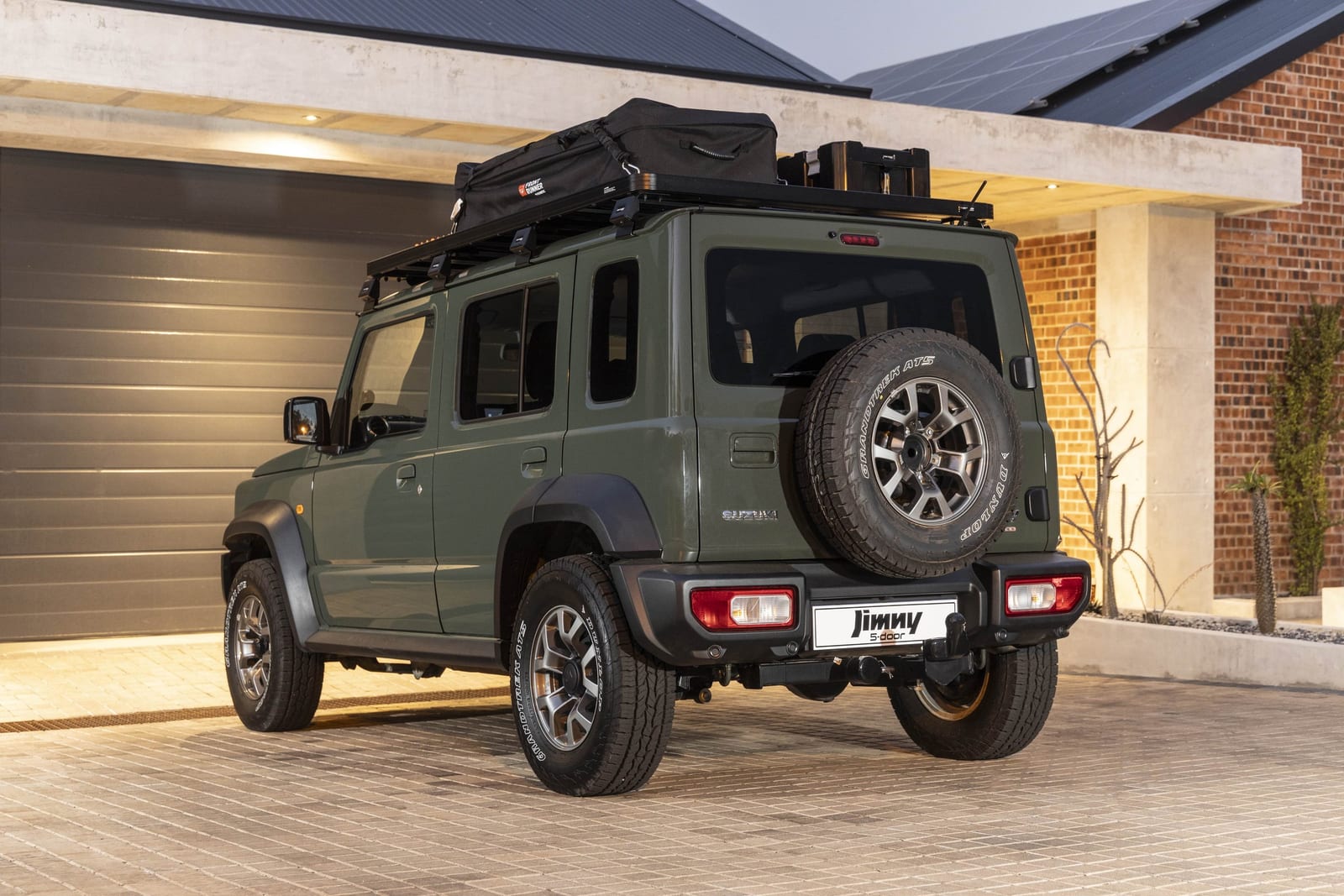
Suzuki SA publishes no towing figure for the 5-door. Its spec page lists the weights but has no towing line. The 5-door brochure has no towing figure either, and it lists no Suzuki tow bar among its accessories. The 3-door brochure does list one.
So we cannot tell you the 5-door tows the same as the 3-door, even though it has the same engine, gearbox and 4x4 system. The towing figures you find online for the 5-door come from other countries. They are not Suzuki SA’s figures, so do not use them here.
So here is what to do. Ask a Suzuki dealer for the 5-door’s towing figure in writing before you fit a tow bar. Keep that letter or email with your car’s papers.
There is a real SA towing test, and it used 5-doors. In July 2024, 4x4 Afrika drove three 5-doors about 3,500 km through Botswana. Two of them towed about 750 kg each. That shows what the car did on one trip. It is not a rating.
A longer car is usually steadier with a trailer behind it, but nobody has tested that on a Jimny here. For the rest of the 3-door or 5-door choice, see our 3-door vs 5-door guide and the 5-door review.
Which trailers suit a Jimny
Shop by the number on the trailer’s plate, not the empty weight in the brochure. Brochures lead with the tare because it is the smaller number. The law and your licence go by the plated GVM.
The sweet spot is a trailer with its own brakes, plated at 750 kg or less. It works on a code B licence and sits well inside Suzuki’s rating.
| Trailer | Empty | Plated at | Brakes | Behind a Jimny? |
|---|---|---|---|---|
| Vagabond Rogue teardrop (the one 4x4 Afrika towed) | 560 kg | 750 kg | Run-in | Yes, on code B |
| Typical Venter-type box trailer | Varies | Often 750 kg | Often none | Only with brakes added, or a lower plate |
| Garden trailer, loaded under 350 kg | Varies | Under about 550 kg | None | Yes |
| Conqueror Compact Platinum | 490 kg | 1,500 kg | Not checked | No, the plate is over the rating |
| Full-size caravan | Often over 1,300 kg | Higher still | Varies | No |
Trailer figures from the makers’ own pages and the 4x4 Afrika test, seen 23 September 2026.
The Venter problem. A Venter to the dump or the nursery is the classic SA towing job. But many Venter-type trailers are plated at 750 kg. Without brakes, a trailer behind a Jimny may be plated at no more than about 550 kg. So a standard unbraked Venter is illegal behind a Jimny, even when it is empty. Your outs are a braked trailer or a lighter one. If you want the plate changed, ask your licensing office.
A few tips, most of them from owners who have towed with Jimnys for years:
- Match the wheels. A trailer on 15 inch wheels, like the Jimny’s, rolls easiest. Small 10 inch wheels feel like the handbrake is on, and they drink fuel.
- Match the track. A trailer whose wheels follow the Jimny’s tracks is far easier in sand.
- Buy it braked. A Pretoria owner who has towed many trailers had to add brakes to his later. He wishes he had bought it braked.
- Match the hitch height. One owner measured about 490 mm to the top of the tow ball on a standard Jimny. A lift raises it.
- Carry water in the trailer. Many small camping trailers have their own water tank. That keeps the weight off the car.
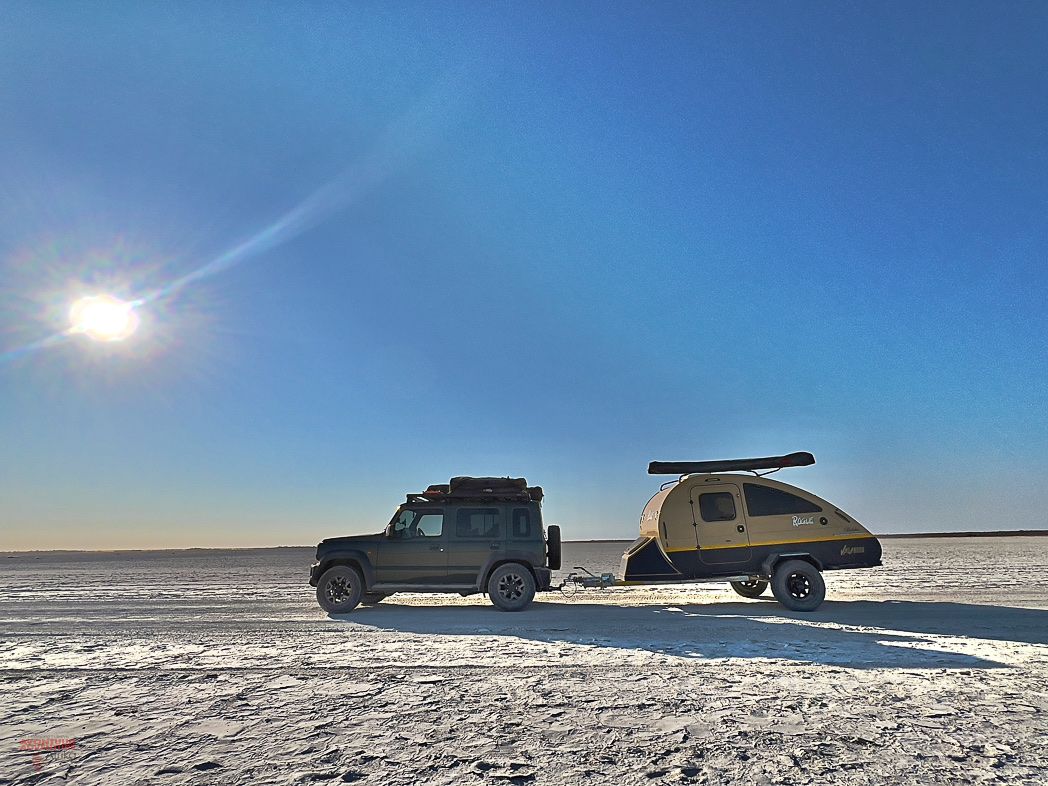
Why tow at all? For most Jimny owners, the trailer is the extra boot. The 3-door’s boot is tiny with the seats up, and the roof may carry only about 30 kg, rack included (see our roof rack guide and rooftop tent guide). A trailer carries the camp behind you instead of on top.
It also suits the way South Africans camp in Kruger or the Kgalagadi. You pitch camp on the trailer in the afternoon, unhitch, and go on the evening game drive in an empty car.
What towing with a Jimny is really like
A Jimny pulls a small braked trailer fine. It just does it slowly, and it drinks fuel. The owners who tow a lot say the same thing: you are not going to fly, so enjoy the drive.
Speed. On flat tar, owners cruise at about 100 km/h with a small trailer. 4x4 Afrika’s test cars sat at about the same speed through Botswana. On steep climbs the Jimny loses a lot of speed. Another owner, towing about 300 kg, held 90 km/h at best.
Hills. The 1.5 makes its best pull high up in the revs, and there is no turbo to help. So you use the gears and keep the engine spinning. On 4x4 Afrika’s trip, the auto kept dropping to third at about 5,000 r/min. The manual held fifth and used less fuel. If you plan to tow a lot, that trip says the manual is the better pick.
Wind and trucks. A short car gets pushed around by a trailer. A Somerset West owner towing a small box trailer on the N2 felt it most in crosswinds and behind trucks. He kept to 100 km/h. His rule is a good one: when in doubt, don’t.
Load it right. 4x4 Afrika’s bike trailer swung from side to side at times, and the tester put that down to how the load sat. Pack it with care, and keep some weight on the tow ball. Check the tow bar’s plate for the most it may carry there.
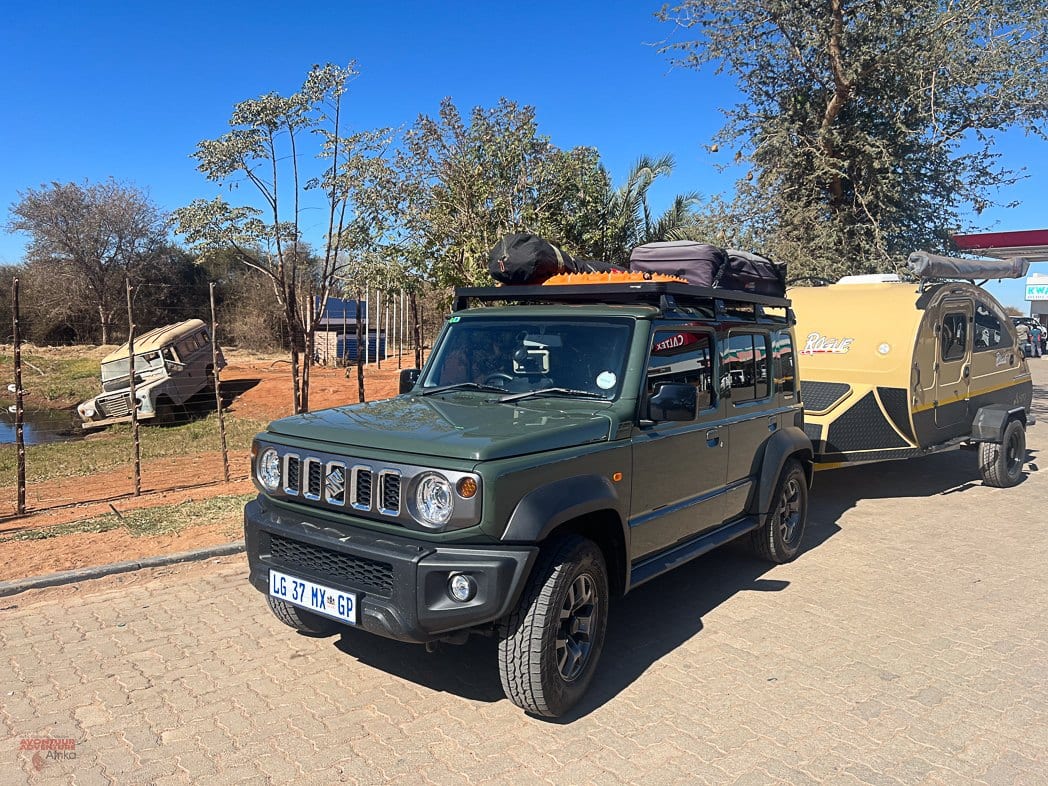
Fuel and range. Towing roughly doubles what a Jimny uses. Here is what 4x4 Afrika measured in Botswana. The trailers were different, so read it as a guide, not a lab test.
| Test car | Towing | Fuel used | In km/l |
|---|---|---|---|
| 5-door auto | 750 kg teardrop, in fourth gear | 11.8 to 12.5 L/100 km | About 8 to 8.5 km/l |
| 5-door auto | Same, when it dropped to third | Over 13 L/100 km | Under about 7.7 km/l |
| 5-door manual | About 750 kg of bike trailer | About 9.6 L/100 km | About 10.4 km/l |
Source: 4x4 Afrika, “Can a Jimny tow a small caravan?”, 26 July 2024.
With a 40 litre tank, the towing auto managed about 300 km on a tank. In the Karoo, the Northern Cape, Botswana or Namibia, that means planning every fuel stop. Carry a jerry can, or look at a bigger tank.
Reversing in sand. Run-in brakes have one catch. When you reverse, the trailer pushes on the hitch, and the brakes come on. 4x4 Afrika’s tester got stuck in sand, tried to back out, and the trailer brakes stopped the car. The Jimny just dug in deeper. In soft sand, keep moving forward and avoid tight turns.
Tow bars: the options
| Option | What it is | Fits | Price seen |
|---|---|---|---|
| Suzuki dealer tow bar | Suzuki’s own accessory, fitted by the dealer | 3-door (the 5-door brochure lists none) | Ask your dealer. One owner paid about R8,700 fitted on a dealer special in late 2025 |
| Zombie Offroad Gen 4 tow bar kit | Bolt-on bar with a removable hitch and the wiring | Current Jimny (the page does not say 3-door or 5-door) | R5,495 |
| Des Sol rear bumper with tow bar | Steel bumper with the tow bar built in, plus recovery points | Current 3-door and 5-door | R16,495 to R16,999 |
| Wildog steel rear bar with hitch | Steel rear bar with a hitch | Current Jimny | R13,500 (sold out) |
Store prices seen on 23 September 2026.
Under warranty, the dealer bar is the easy choice. Suzuki SA says it stands behind work done at its dealers. It treats other makers’ parts case by case. An aftermarket tow bar does not void your warranty. But a claim on a part it touches may be questioned.
The bolt-on kit is the cheapest route. Zombie Offroad’s kit comes with the wiring, and its page says no drilling or welding is needed.
The Des Sol bumper suits people who go off-road with a trailer. It tucks the tow bar up into the bumper, so it does not hang low and catch on rocks. Des Sol says the bumper does not raise the car’s towing figure. A stronger tow bar never does.
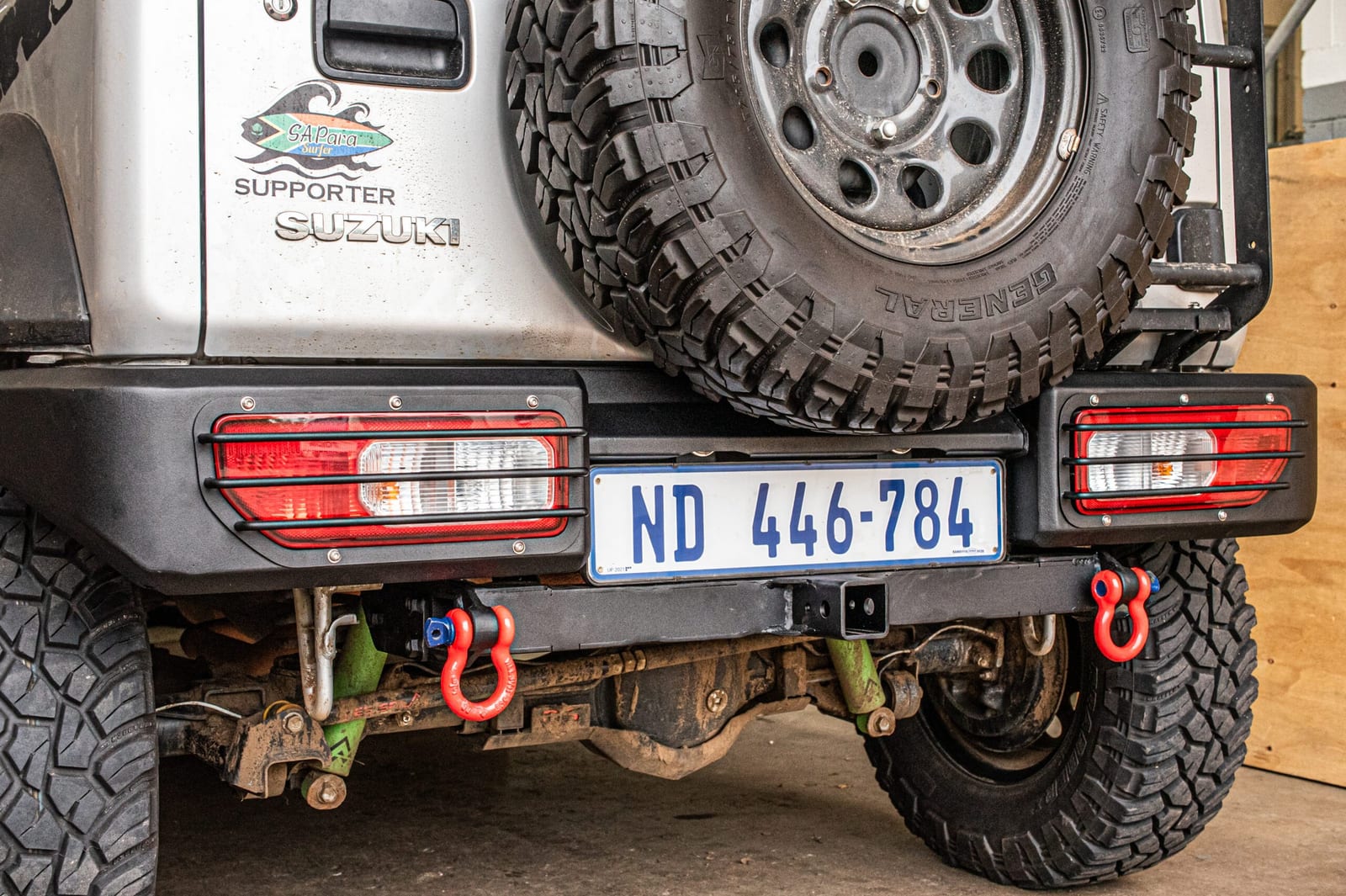
Live prices · 4 October 2026
Rear bumpers with a tow bar, in stock now
5 in stock at 5 stores today, from R16 495 to R16 999. Typical price about R16 999.
A few more tow bar rules:
- Buy a branded tow bar with a data plate that shows its rating, and keep the invoice.
- Do not tow a trailer on an extension bar. Owners fit these to clear the spare wheel for a bike rack. An extension adds leverage on the tow bar and the chassis. Use it for a bike rack only.
- Tell your insurer about the tow bar. Pineapple, for one, lists tow bars as accessories you must declare. And if you tow more than the law, your licence or Suzuki allows, your insurer has a reason to turn down a claim. Ask them.
Our rock sliders and bumpers guide covers rear bumpers in more detail, and the bumpers page has every one with today’s price.
Suzuki Jimny load capacity
Load capacity is what the car may carry on top of its own weight. Suzuki sets the most each Jimny may weigh fully loaded, its GVM. Take away the empty weight, and you get what you can load.
| Jimny | Weight empty | Most it may weigh (GVM) | What it can carry |
|---|---|---|---|
| 3-door manual | 1,095 kg | 1,450 kg | About 355 kg |
| 3-door auto | 1,110 kg | 1,450 kg | About 340 kg |
| 5-door manual | 1,185 to 1,200 kg | 1,545 kg | About 345 to 360 kg |
| 5-door auto | 1,200 to 1,215 kg | 1,545 kg | About 330 to 345 kg |
Weights from Suzuki Auto South Africa’s spec pages and brochures, seen 23 September 2026.
That load covers everything. You, your passengers, your bags, the fridge, a roof rack, and the weight the trailer pushes down on the tow ball. Four adults of 80 kg each already weigh 320 kg. So a full car leaves very little room for the trailer’s nose.
Stronger springs make a loaded Jimny sit level. They do not let it carry more, as our lift kits guide explains. The real fix for a heavy load is to move it out of the car and into a trailer. Our storage and cargo guide covers packing the space you do have.
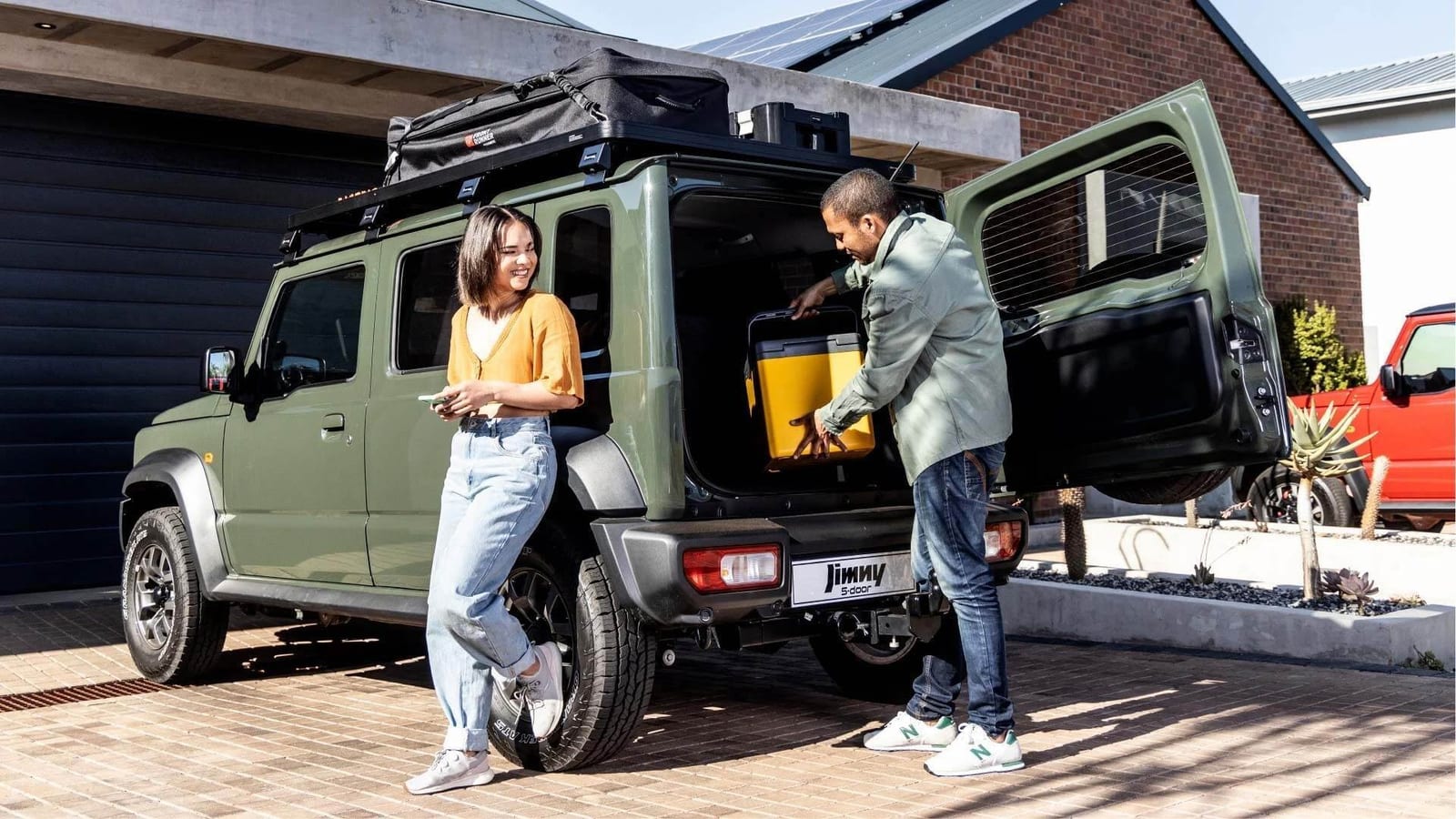
Suzuki Jimny specs in South Africa
The 3-door and 5-door share the engine, gearboxes and 4x4 system. The 5-door is longer, heavier and roomier. Here is the full sheet, from Suzuki Auto South Africa.
| Spec | 3-door | 5-door |
|---|---|---|
| Versions on sale | 1.5 GLX manual, 1.5 GLX auto | 1.5 GL manual, 1.5 GLX manual, 1.5 GLX auto |
| Engine | 1.5 litre petrol, 4 cylinders, no turbo | Same |
| Power | 75 kW at 6,000 r/min | Same |
| Torque | 130 Nm at 4,000 r/min | Same |
| Gearbox | 5-speed manual or 4-speed auto | Same |
| 4x4 | 2H, 4H and low range 4L | Same |
| Towing, braked / unbraked | 1,300 kg / 350 kg | Not published |
| Weight empty | 1,095 to 1,110 kg | 1,185 to 1,215 kg |
| Most it may weigh (GVM) | 1,450 kg | 1,545 kg |
| Length | 3,485 mm | 3,820 mm |
| Wheelbase | 2,250 mm | 2,590 mm |
| Ground clearance | 210 mm | 210 mm |
| Approach / breakover / departure angle | 36 / 27 / 47 degrees | 36 / 24 / 47 degrees |
| Turning radius | 4.9 m | 5.7 m |
| Boot, seats up | 85 litres | 211 litres |
| Boot, most | 830 litres | 1,113 litres |
| Fuel tank | 40 litres | 40 litres |
| Claimed fuel use | 6.3 L/100 km manual, 6.8 L/100 km auto | Not published |
| Tyres | 195/80 R15 96S | 195/80 R15 96S |
| Front / rear brakes | Solid disc / drum | Vented disc / drum |
| New car warranty | 5 years or 200,000 km | Same |
| Service plan | 4 years or 60,000 km | Same |
Seen on Suzuki Auto South Africa’s spec pages and brochures on 23 September 2026. The 3-door fuel figures are from the July 2026 brochure. The two bodies’ boot figures are measured in different ways, so compare them with care.
A few of these numbers need plain words.
The engine. The 1.5 makes its most pulling power high in the revs, at 4,000 r/min. With no turbo, it does not pull hard low down. On a trailer, that means using the gears. It also loses some power on the Highveld, as any engine without a turbo does.
Low range. You pull a lever to go from 2H (rear-wheel drive) to 4H (four-wheel drive) and 4L (low range). Low range is a set of very low gears for slow, careful crawling, in sand or up a steep track. Suzuki calls the system AllGrip Pro. It is the real thing, not a light 4x4 system for wet roads.
Turning radius. The 3-door turns in very little space. The 5-door needs about 1.6 m more road to turn around. That matters when you have to turn a trailer on a narrow track.
Fuel. The claimed figures work out to about 15.9 km/l for the manual and 14.7 km/l for the auto. Real driving uses more, and towing uses about twice as much.
Warranty. The 5-year warranty is for new cars bought from a Suzuki dealer. A used buyer gets whatever time is left on it.
For the tyres, and what else fits, see our Jimny tyre size guide. For what the Jimny can do off-road, see is the Jimny a good 4x4.
Who should tow what
| You | Your best setup |
|---|---|
| Want to camp further, with no rooftop tent | A braked teardrop or small camping trailer, plated at 750 kg or less, on a code B licence |
| Go properly off-road with the trailer | A bumper tow bar that sits high, a braked off-road trailer, and extra fuel |
| Tow a bike trailer now and then | A light braked trailer. Watch the load in the car |
| Take garden refuse to the dump | An unbraked trailer only if its plate is under about 550 kg and the loaded trailer is under 350 kg. Otherwise, a braked one |
| Own a 5-door | Get Suzuki’s towing figure from a dealer in writing first |
| Tow a caravan, boat or car trailer often | Not a Jimny job. A bakkie or bigger SUV tows far better |
Several owners on the forums say it plainly. You do not buy a Jimny to tow. If towing is the main job, a double cab for similar money does it far better. But as an extra boot on wheels, a small braked trailer turns a Jimny into a proper touring car.
The bottom line
Suzuki SA rates the 3-door Jimny to tow 1,300 kg braked and 350 kg unbraked. For most owners, the real limit is lower: a braked trailer plated at 750 kg or less, on a code B licence. Suzuki SA publishes no figure for the 5-door, so get one from a dealer in writing. Read the trailer’s plate, not the brochure. Plan for about 100 km/h, twice the fuel and 300 km a tank. And keep an eye on the load in the car, because the tow ball’s share comes out of the same 330 to 360 kg.
Shopping for one? Browse the latest Jimny listings and see how prices are moving on our live market page. Then check what a Jimny is worth before you buy or sell.
A big thank you to Anton Willemse and 4x4 Afrika for the photos from their Botswana tow test. Thanks too to Des Sol in Pinetown for the tow bar photo, and to Suzuki Auto South Africa for the press photos. Go and read the full test, and support the people who keep South Africa’s Jimnys on the road.