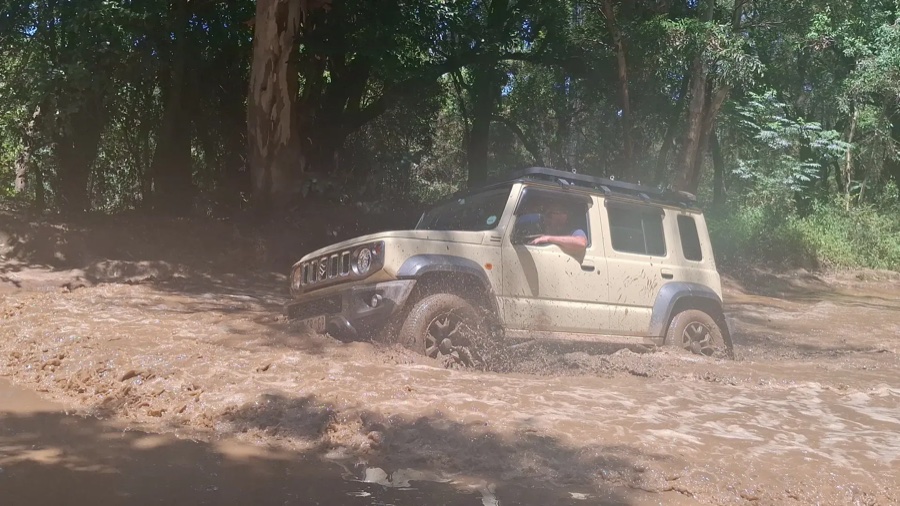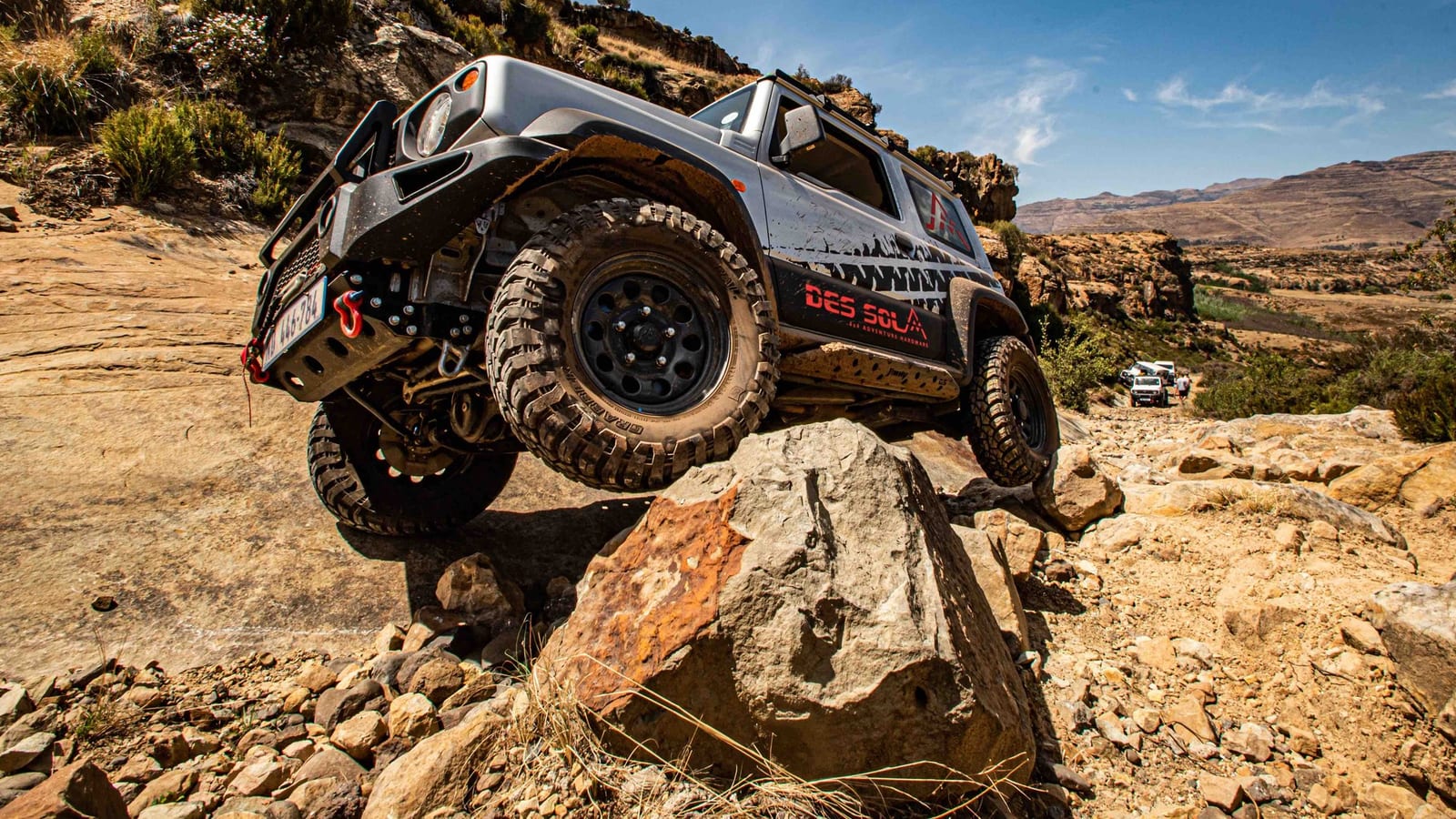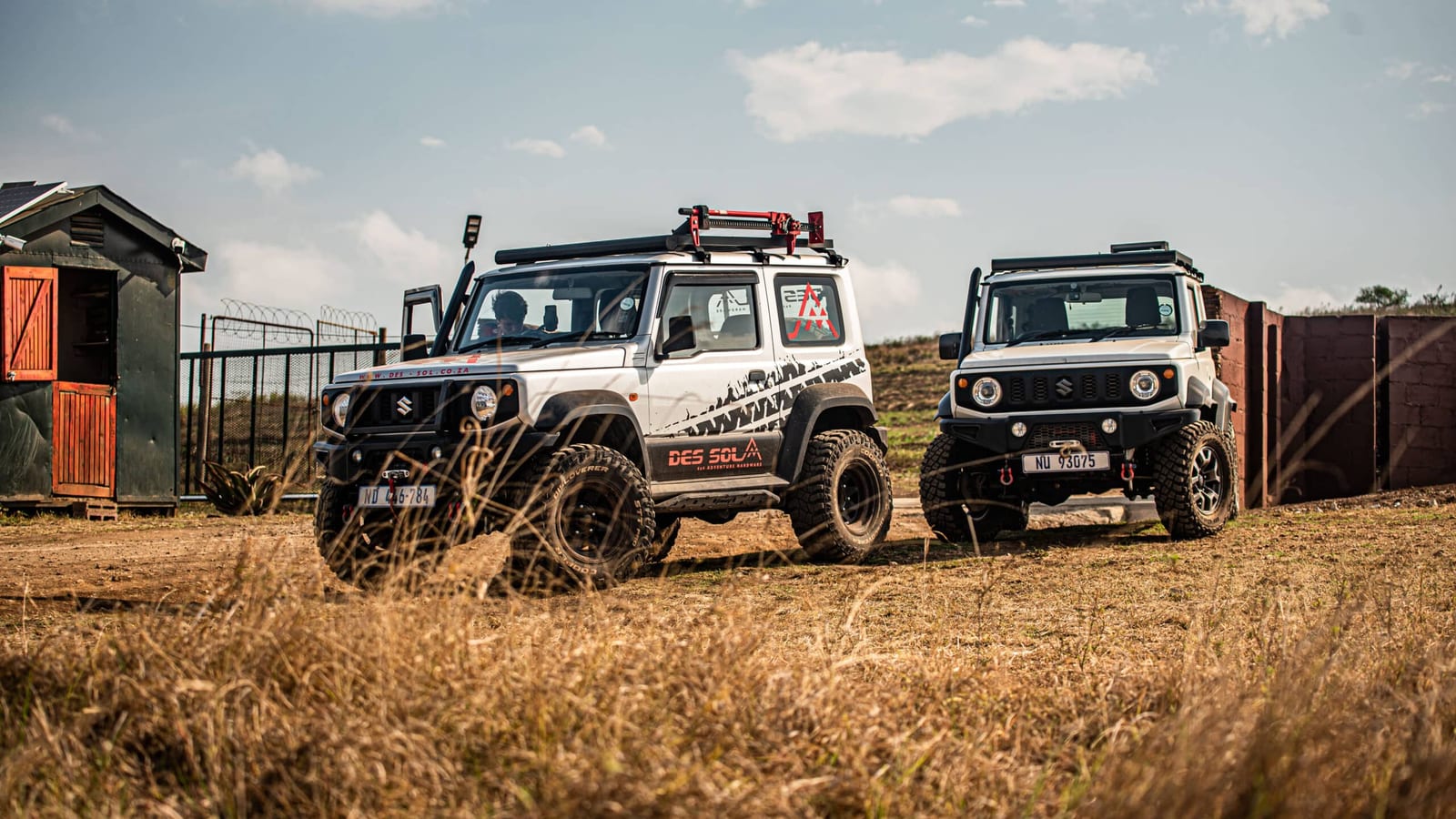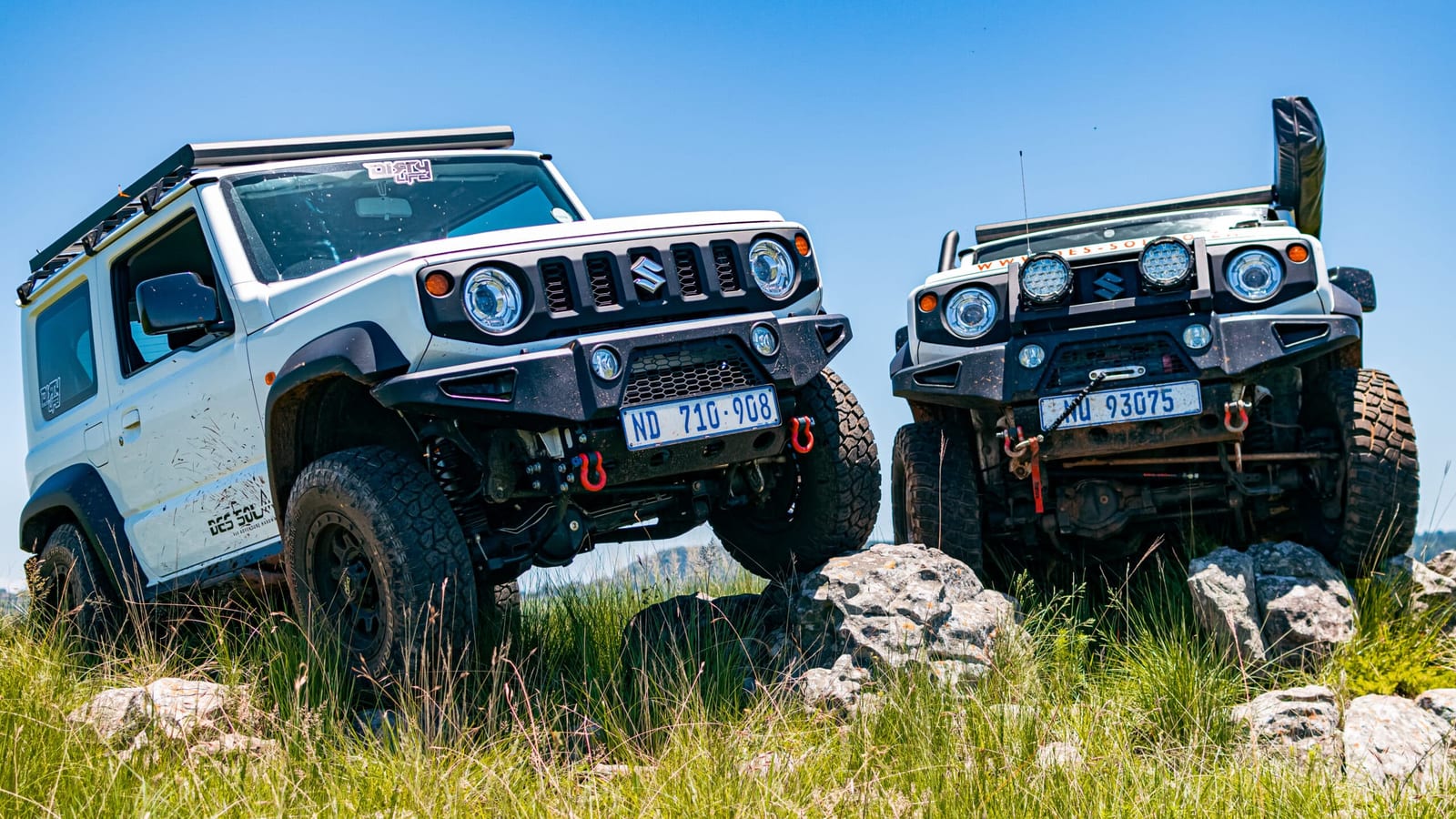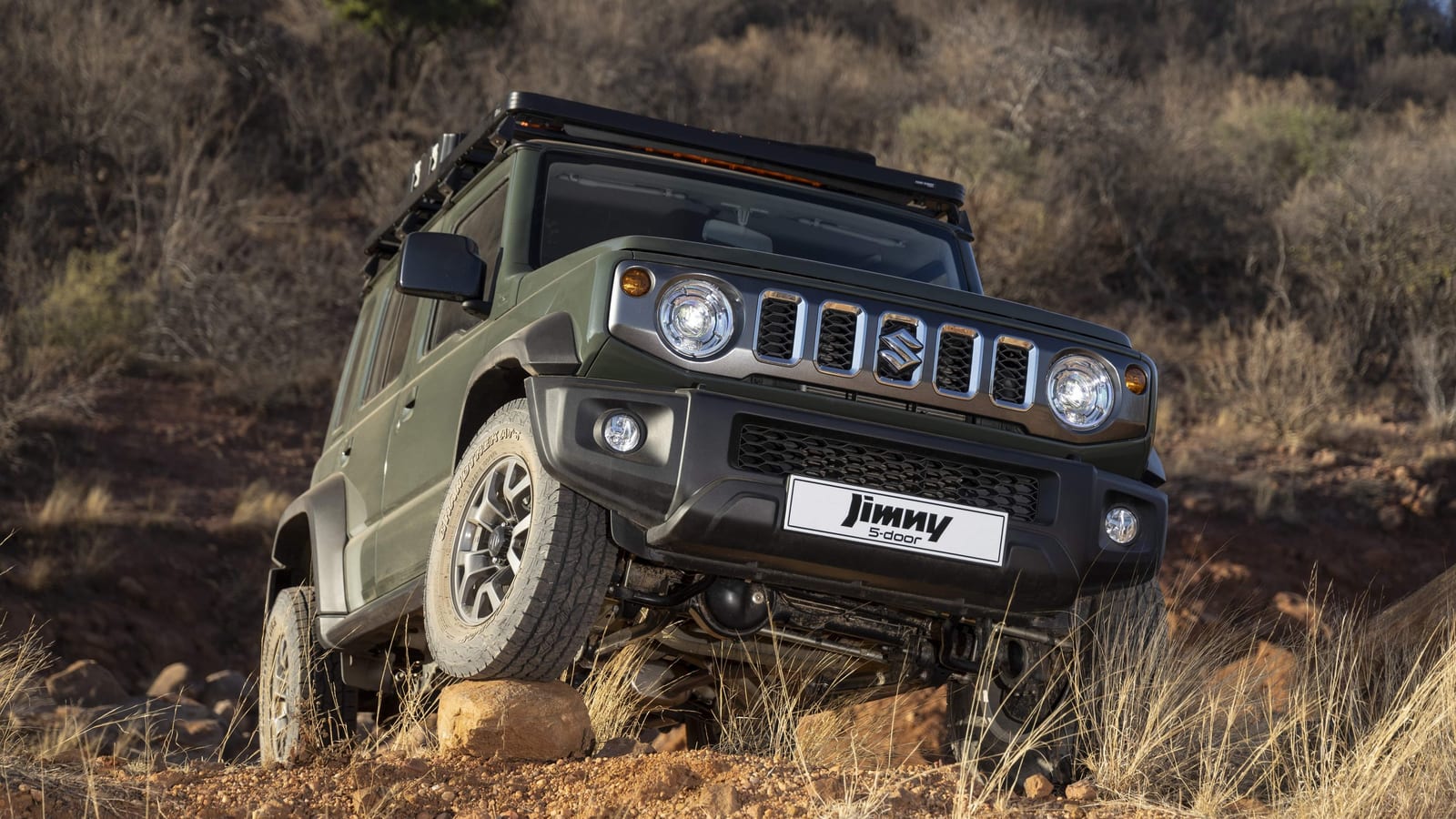
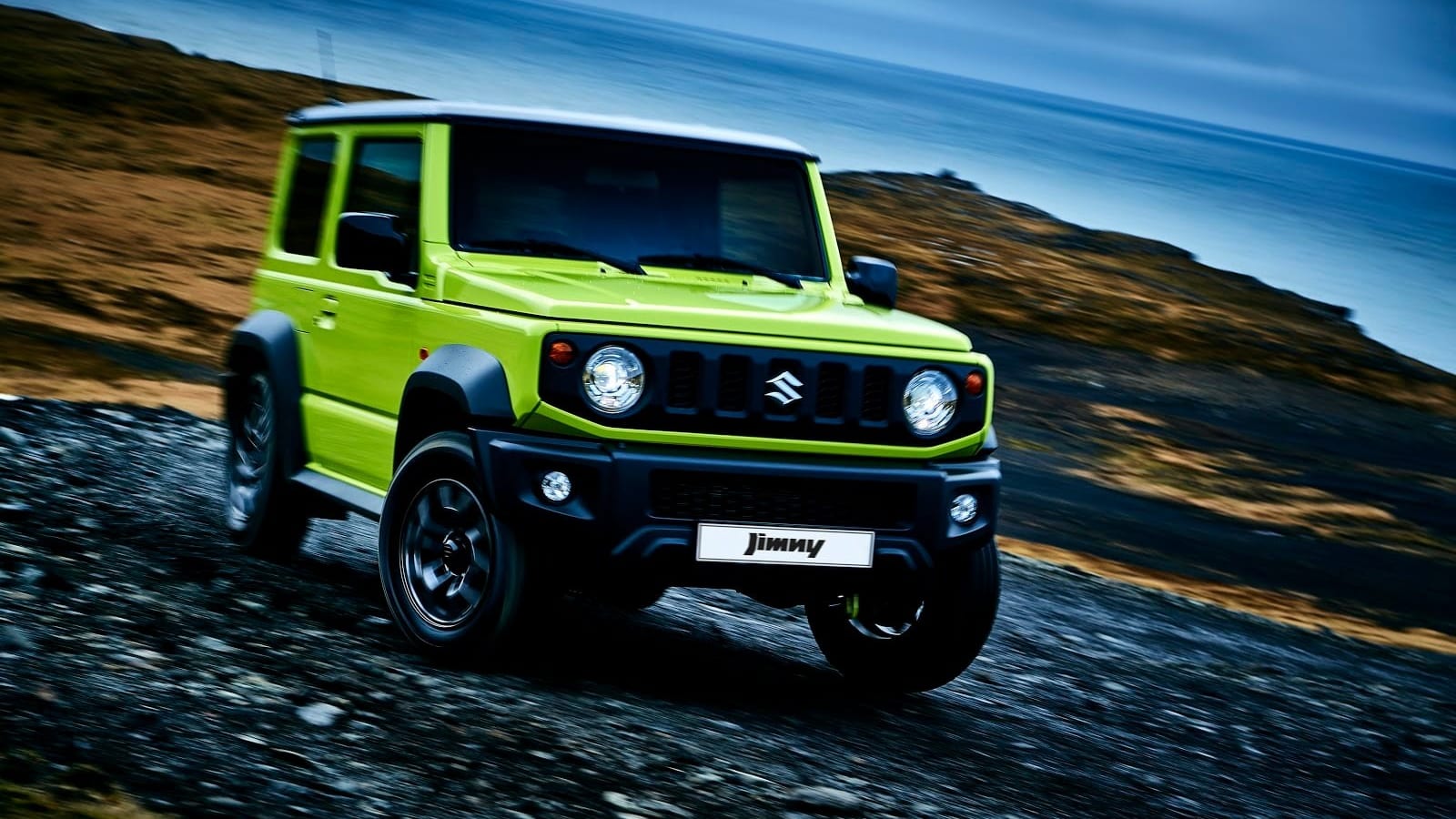
Cover photo: Suzuki Auto South Africa, showing the standard 3-door the way most first-time owners use it: out on the road, not in a showroom. With thanks.
The Suzuki Jimny is the small, boxy Suzuki 4x4 that has become a regular in student parking from Stellenbosch to Pretoria. It is cute, it goes anywhere, and young drivers love it. So it lands on a lot of first-car shortlists.
Usually the person reading this is a parent, asking: is it safe, and is it sensible? This guide answers that first, then covers the highway, running costs and prices.
The short answer
- Yes, for the right driver. It suits a new driver who drives in town and also uses gravel, farm roads or weekend trips. It is easy to park and hard to drive wildly.
- Buy the safety kit. Choose a version with six airbags. Most used 3-doors built before March 2026 have only two.
- Not for a tar-only highway commute. On a long, windy N1 run it is hard work for a new driver. A small hatch or crossover is calmer, cheaper to run and roomier.
What the Suzuki Jimny is
The current Jimny has been on sale in South Africa since late 2018. It is a small car with a real 4x4 system, low range and 210 mm of ground clearance. Every version uses the same 1.5-litre petrol engine, with no turbo. You can have a manual or a 4-speed automatic.
There are two bodies. The 3-door is very short. The 5-door arrived in 2023 and is longer, with a usable boot. Both seat only four people. Our 3-door vs 5-door guide covers the choice in full.
The older Jimny (1998 to 2018) has a 1.3-litre engine. It is the cheap way in, and we cover it near the end.
Suzuki Jimny safety rating in South Africa
South Africa has no crash test body of its own. Buyers here rely on the tests done overseas on the same car.
The current Jimny 3-door was crash tested in 2018 by Euro NCAP and by ANCAP, its Australian partner. They share one test. It scored 3 out of 5 stars. That rating has since expired: ANCAP marks it “Expired (Dec 2024)”. An expired rating does not mean the car got worse. It means the test is old.
| What was tested | Score |
|---|---|
| Adults inside the car | 73% |
| Children inside the car | 84% |
| People outside the car (walkers, cyclists) | 52% |
| Driver aids, like automatic braking | 50% |
Source: ANCAP, test year 2018.
The detail is more useful than the stars. The Jimny scored full marks in the side crash test and the pole crash test. A pole crash is like sliding sideways into a tree. It also scored full marks for how well child seats fit.
It lost points mainly in the head-on tests and the driver aid tests. In the offset crash, the driver’s airbag did not hold enough air, so the dummy’s head hit the steering wheel. The cabin also bent around the door frame. Its automatic braking also did poorly at spotting people and cyclists.
The catch for SA buyers
The car Euro NCAP crashed had six airbags and automatic braking. Most Jimnys sold in South Africa did not.
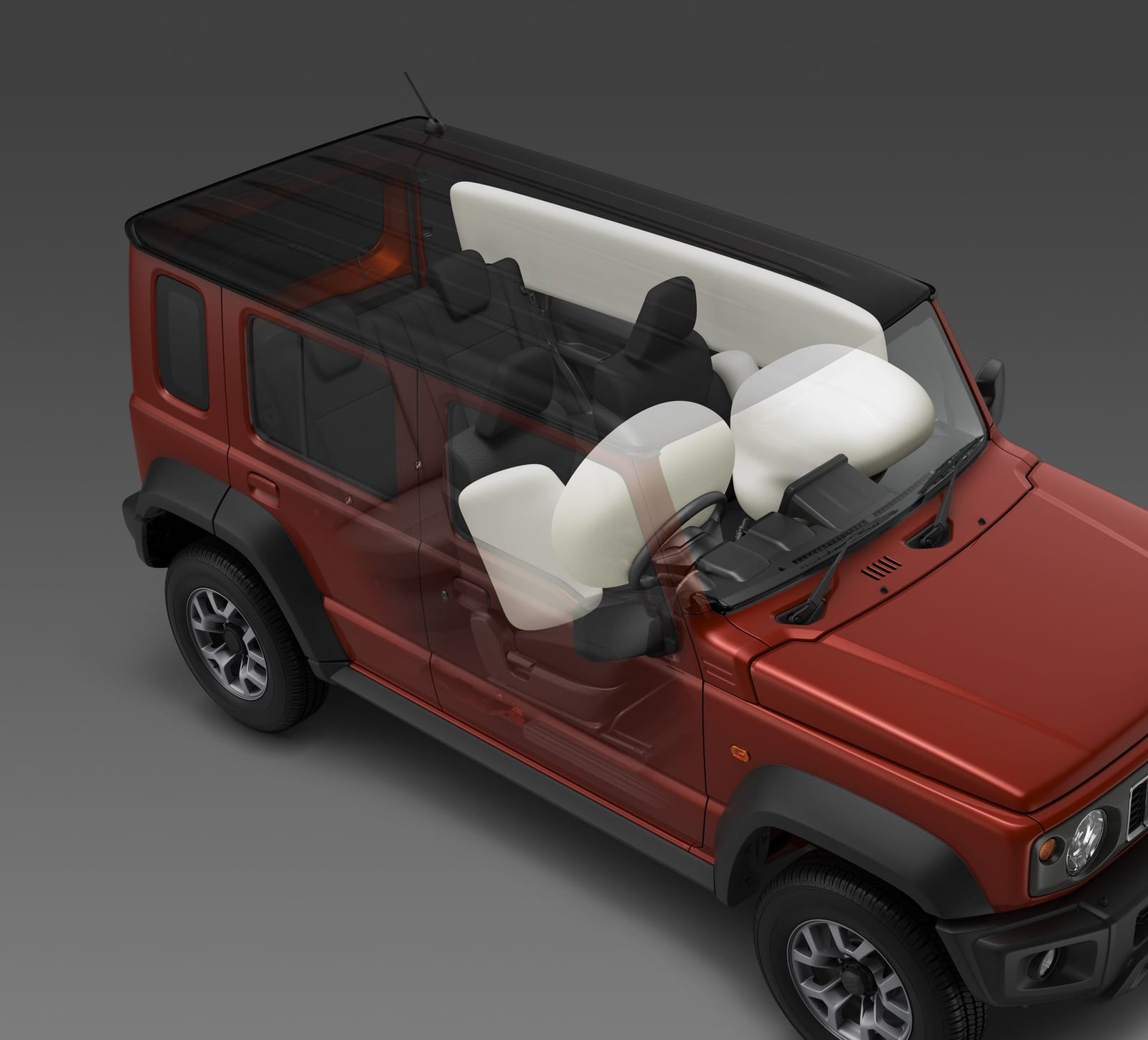
SA 3-doors built from 2018 to early 2026 have two front airbags and no automatic braking. In March 2026, Suzuki made six airbags standard on the 3-door. It also added an optional pack called DSBS II, for R15,000 more. DSBS II uses a camera and a laser sensor, and it can brake the car by itself.
Nobody has crash tested the two-airbag SA car, so nobody can say what it would score. It simply has less safety kit than the car that earned the 3 stars.
The 5-door has never been crash tested by Euro NCAP or ANCAP. Do not apply the 3-door’s stars to it.
The safety kit on each Jimny sold today
Here is what each new Jimny carries, from Suzuki SA’s own spec pages in September 2026.
| Version | New price | Airbags | Brakes by itself? |
|---|---|---|---|
| 5-door GL manual | R439,900 | 2 | No |
| 3-door GLX manual | R444,900 | 6 | No |
| 3-door GLX manual DSBS II | R459,900 | 6 | Yes |
| 3-door GLX auto | R466,900 | 6 | No |
| 5-door GLX manual | R467,900 | 6 | No |
| 3-door GLX auto DSBS II | R481,900 | 6 | Yes |
| 5-door GLX auto | R489,900 | 6 | No |
Every version has ABS, stability control (ESP), brake assist, a reverse camera and two Isofix points for child seats. The DSBS II cars also warn you when you drift out of your lane, and their cruise control keeps a gap to the car ahead.
Two things stand out for a parent. The cheapest new Jimny, the 5-door GL, is also the one with two airbags. And no 5-door in South Africa can brake by itself.
So if safety comes first, buy a GLX. The 3-door GLX with DSBS II carries the most safety kit of any Jimny sold here. On a used 3-door, count the airbags on the exact car before you pay. Our GLX vs GL guide covers the rest of the trim differences.
Is the Jimny safe for a new driver?
Owners split into two honest camps here.
The first camp asks, “Safe compared to what?” A Jimny is not a big, heavy SUV. It is less safe than a new hatch of the same weight. But it is safer than a 20-year-old hatch, or the older Jimny. And it has habits that suit a new driver.
- You can see the corners. The body is square and you sit high. A Centurion 5-door owner says this teaches a new driver exactly where the car is.
- You cannot drive it wildly. The same owner says the car makes you drive calmly and pay attention all the time.
- It calms young drivers down. One father on 4x4community said his son drove his Polo GT hard. After a swap to a Jimny, the boy calmed right down and now cruises at about 110.
The second camp is just as experienced. A Jimny is short, tall and narrow, with solid axles front and back, the old-school 4x4 layout that is tough off road. That makes the steering less precise than a normal car’s, and bumps knock it off line more easily. A car like that starts at a disadvantage, and the driver has to make up for it. So the real question is the young driver’s temper, not the car.
A few more things a new driver must know:
- It is slow. Owners call the engine “adequate”. It gets to 120 km/h, but overtaking a truck takes planning. On a long, steep climb, tuck in behind the truck and wait.
- It drives the back wheels. In normal driving, only the back wheels push the car. On wet or loose gravel, switch to 4x4 (4H). Our Jimny 4x4 guide explains how.
- Drive it like a Jimny. A Tzaneen owner of 40 years sent all three sons to varsity in Pretoria in old Suzukis. His advice: drive it like a Jimny, not a sports car, and you will be fine.
Several SA parents treat a defensive or advanced driving course as part of the first-car package. It is money well spent in any car.
How it drives on the highway
This is the Jimny’s weak spot, and SA owners will tell you so.
It is tall, it weighs about 1,100 kg, and it has a flat, boxy side. CAR magazine says that makes it very sensitive to crosswinds. On a windy day at the national limit, it needs small steering corrections all the time, and your full attention. The Cape south-easter on the N2, and the August wind on the Highveld, are the classic tests.
On a calm day it holds 120 km/h. One SA motoring test of the 5-door found it happiest at about 90 to 100 km/h.
Three more things to check:
- The 5-door is calmer. Its wheelbase (the gap between the front and back wheels) is 340 mm longer, so it is steadier on the open road.
- The auto has four gears. CAR says the 4-speed auto is noisy on the highway and uses more fuel. It steers used buyers to the 5-speed manual. In town, the auto is fine.
- Feel for a shimmy. Some Jimnys get a steering shake at 70 to 90 km/h. Careful wheel balancing usually fixes it. Test drive at those speeds. Our common problems guide covers it.
If the car feels jumpy on the test drive, check the tyre pressures before you judge it. Some cars leave the dealer with them pumped too high. Our tyre size guide has the right pressures.
Easy to park, small inside
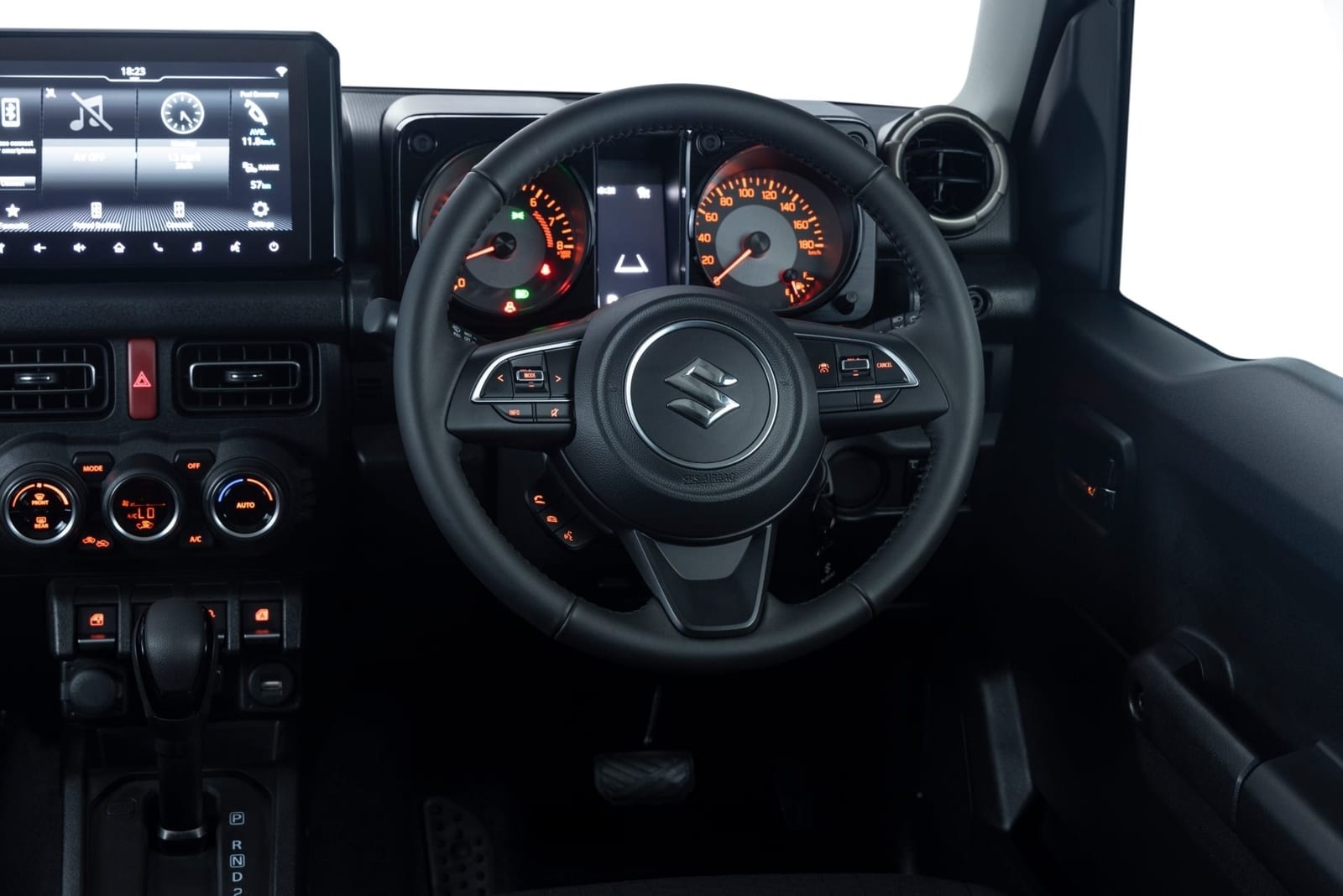
In town, the Jimny is at its best. Here are the numbers from Suzuki SA’s brochures.
| 3-door | 5-door | |
|---|---|---|
| Length | 3,485 mm | 3,820 mm |
| Turning radius | 4.9 m | 5.7 m |
| Boot, back seats up | 85 litres | 211 litres |
| Boot, back seats folded | 377 litres | 332 litres |
| Seats | 4 | 4 |
| Ground clearance | 210 mm | 210 mm |
The 3-door is one of the shortest cars on sale here. It turns tightly, and it slots into mall bays with room to spare. One father said his daughter’s big win is parking: it fits anywhere.
The 5-door is a different story. It needs more room to turn, and on a narrow farm road it takes a three-point turn where the 3-door turns in one go.
The 210 mm of clearance is a real SA first-car point. Speed humps, potholes, broken rural roads and the gravel road to the farm do not worry it.
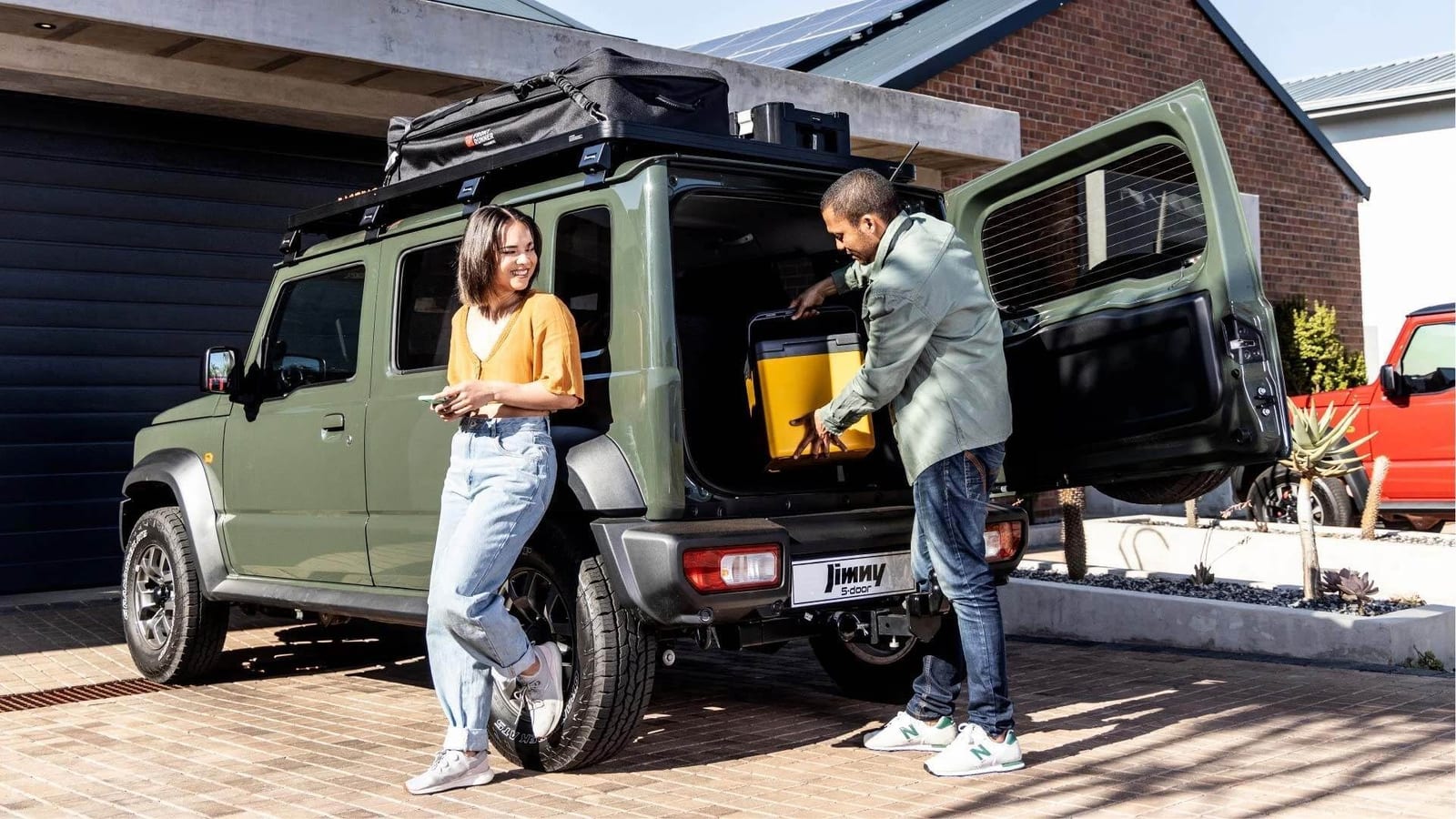
The limits are just as real. Both bodies carry only four people, so your child cannot give three friends a lift home. And the 3-door’s boot holds 85 litres with the back seats up. That is a couple of school bags. If the first car must carry friends and their bags, buy the 5-door.
Running costs: fuel, services, insurance
Fuel
Here is what Suzuki SA claims each Jimny uses.
| Version | Suzuki’s claim | About, in km/l |
|---|---|---|
| 3-door manual | 6.3 l/100 km | 15.9 km/l |
| 3-door auto | 6.8 l/100 km | 14.7 km/l |
| 5-door manual | 6.4 l/100 km | 15.6 km/l |
| 5-door auto | 6.7 l/100 km | 14.9 km/l |
Those are lab figures. Real use is higher, most of all at 120 km/h, where the boxy shape pushes a lot of air. The auto, bigger tyres and a roof rack all add more. One SA long-term test of a 3-door auto used 8.5 l/100 km, about 11.8 km/l. Owners who drive standard cars mostly report 11 to 13 km/l.
In short, it is good on fuel for a 4x4, but thirsty for a small car. A student who pays for fuel will feel it. The tank holds 40 litres on both bodies, so expect to fill up often on a long trip.
Warranty and services
A new Jimny currently comes with Suzuki’s five-year or 200,000 km warranty, and a four-year or 60,000 km service plan. It needs a service every 15,000 km or once a year. Suzuki calls the warranty a promotion, so check what applies on the day you buy.
Most first cars are used, though. A 2020 or 2021 Jimny is past its four-year service plan, and its warranty is ending or already over. Ask a Suzuki dealer to check the car’s VIN (its identity number) for cover left and open recalls. Some 2019-built 3-doors had a fuel pump recall.
Insurance
We could not find a trustworthy insurance figure for a Jimny with a young driver. Online estimates we checked had mistakes in them, so we will not print one.
For a new driver, insurance is often the biggest monthly cost after the car payment. The premium depends on the driver as much as the car. Get three quotes on the exact car before you buy, and ask if the insurer wants a tracker fitted.
If a used Jimny has a lift, bigger tyres or a bull bar, declare every part. OUTsurance, for example, only covers extras you have told it about. Buying on finance? Read our finance guide.
Break-ins
SA owners do not report the Jimny as a hijack favourite. What they do report is break-ins. In Cape Town and Gqeberha, owners say thieves break the driver’s door lock in beach and city car parks. Leave nothing valuable in the car. Some owners there fit a cover over the driver’s door lock.
What a first Jimny costs
These are asking prices on live listings, analysed daily, from 23 September 2026. They are not what cars sold for. New and nearly new stock is left out, because it pushes the figures up.
| Your budget | What you can get |
|---|---|
| Under R150,000 | An older Jimny (1998 to 2018), usually with very high km |
| R150,000 to R250,000 | An older Jimny, or one of about 10 current Jimnys, mostly with high km |
| R250,000 to R300,000 | An early current Jimny, usually a 3-door |
| R300,000 to R400,000 | Most used current Jimnys, 3-door and 5-door |
| About R440,000 and up | New, or nearly new |
A used current Jimny asks about R349,000, across 937 adverts. The cheapest asks R234,900, for a 2022 GL with 111,000 km.
| Model year (used) | Adverts | Asks about | Typical km |
|---|---|---|---|
| 2019 | 30 | R287,000 | 104,000 |
| 2020 | 72 | R300,000 | 59,000 |
| 2021 | 108 | R310,000 | 63,000 |
| 2022 | 186 | R320,000 | 52,000 |
| 2023 | 115 | R345,000 | 40,000 |
| 2024 | 308 | R370,000 | 33,000 |
| 2025 | 109 | R400,000 | 17,500 |
By body, a 3-door from 2018 to 2022 asks about R310,000. A 5-door asks about R375,000.
The Jimny holds its value well in rands. A 2019 car with about 100,000 km still asks close to R290,000. In 2018 a new GLX manual cost R299,900. Part of that is big rises in new prices, so do not expect it to hold forever.
Right now, prices are drifting down. In the last 90 days, three in four price changes on current Jimnys were cuts, usually of about R10,000. So there is room to talk. Before you pay, check the car’s price against our Jimny valuation tool. Our price by year guide and resale value guide go deeper.
The budget route: the older Jimny
Under R250,000, you are shopping for the older Jimny (1998 to 2018). There are 194 on live listings, and they ask about R190,000. Most have more than 100,000 km, and the cheapest ones are all manuals.
It is a different, older car. It has a smaller 1.3 engine and an older design. Check what safety kit the exact car has, and have a mechanic look it over. Browse them on our older Jimny listings.
Manual or auto, 3-door or 5-door
Gearbox. SA parents argue about this one. The common ground is sensible: take the K53 driving test in a manual, so you can drive any car later. Then buy the gearbox that suits the driving. For town, the auto is easy. For long trips, the manual is the better Jimny. Used autos outnumber manuals, 580 adverts to 357. They ask about R30,000 more, partly because they are younger.
Body. The 3-door is the better city car. It is shorter and turns tighter. The 5-door is steadier on the open road, has a real boot, and makes the back seats usable. For a new driver who will do long trips, most owners who know both say the 5-door.
Test drive both. Take the car onto a freeway, up a hill and along a road with a camber. Let the parent drive it too.
Jimny, or a Swift or Fronx?
This is the real argument in SA families. The rivals parents compare are a Suzuki Swift, a Suzuki Fronx or its Toyota twin, the Starlet Cross, a Renault Duster or a Chery Tiggo.
Even many Jimny owners say that for a tar-only first car, a small front-wheel-drive hatch or crossover is the sensible buy. It is calmer on the highway, lighter on fuel, roomier and easier for a novice on a slippery road.
The Jimny earns its place off the tar: the gravel road to the family farm, a varsity weekend in the Cederberg, a camping trip with friends. It is also a car young drivers love and look after. As owners say, you buy a Jimny because you want a Jimny.
There is a big, friendly club scene behind the car too. Just do not pay for the fun with safety. Buy the airbags first.

Who should buy what
| The driver | Our pick |
|---|---|
| Mostly town, some gravel, safety first | New 3-door GLX with DSBS II, or a 5-door GLX |
| Mostly town, tighter budget | Used 3-door. Count the airbags, check the VIN |
| Long trips to varsity or the farm | 5-door GLX manual |
| Tar-only highway commute | A small hatch or crossover, not a Jimny |
| Under R250,000 | An older Jimny, checked by a mechanic, or a different car |
Browse current Jimnys for sale or see the live Jimny market. Once the car is home, our accessories guide shows what owners fit first. Tyres and shocks usually come before anything else.
The bottom line
The Suzuki Jimny can be a good first car in South Africa. It is small, easy to park, tough on bad roads, and it teaches calm driving. But it is not the safest small car you can buy, it is hard work on a windy highway, and it is thirsty for its size.
Buy it for a young driver who will really use the gravel. Buy a version with six airbags, ideally a 3-door with DSBS II or a 5-door GLX. And if the driving is all tar and highway, buy the hatch and save the Jimny for later.
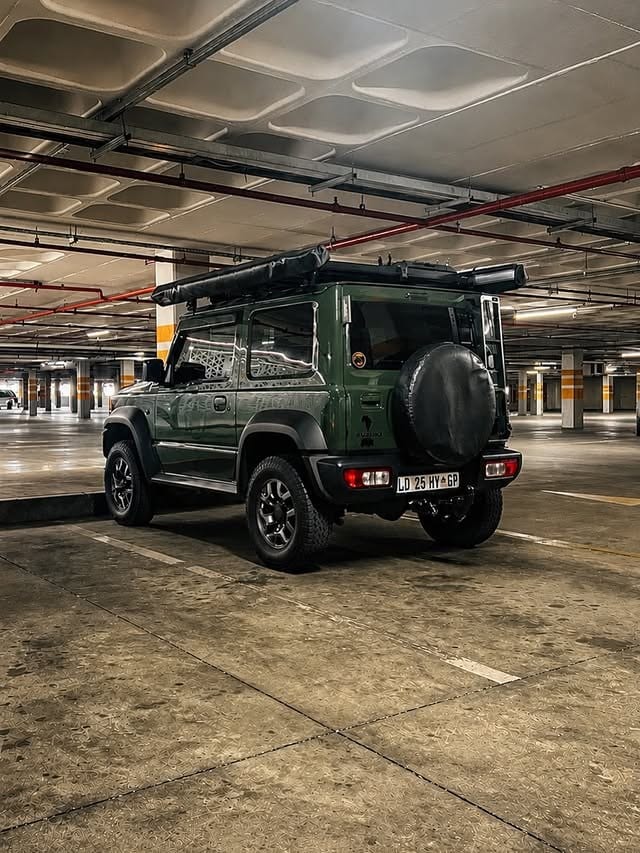
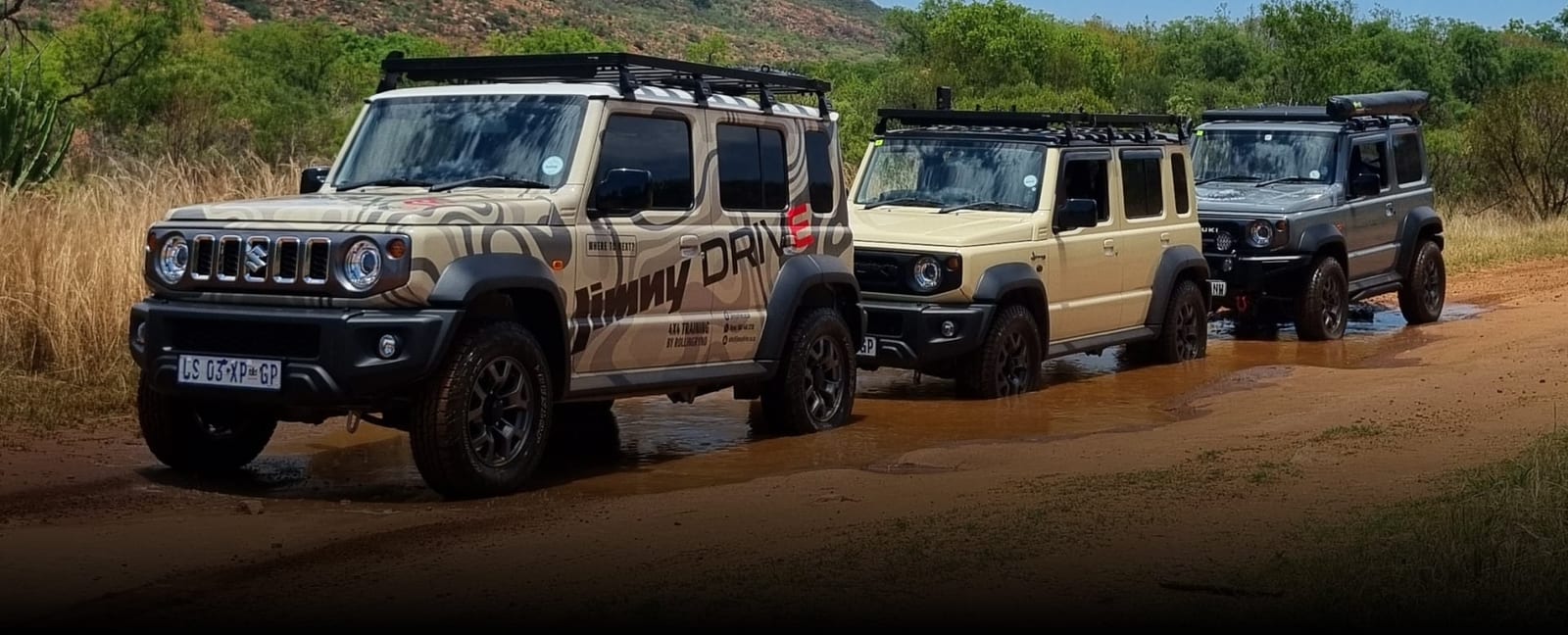
A big thank you to Suzuki Auto South Africa for the photos of the car, the Jimny Drive course and the Jimny Gathering, and to @jimny.cricket.sa for the parking shot. Go and give them a follow.